























Guide · About 7 minutes
What is an advance directive?
An advance directive is a legal paper that says what medical care you want, and who decides for you, if you can't speak for yourself. It's also called an advance health care directive. Most states have a free form, and you don't need a lawyer.
By the KinLine team · Updated
The short answer
- What it is: written instructions for your medical care, used only when you can't speak for yourself, for example after a stroke or a bad car accident.
- What's in it: usually a living will, a health care power of attorney, or both.
- Who needs one: any adult. A medical crisis can happen at any age.
- Cost: little or nothing. Most states have free forms.
Living will vs. health care power of attorney
Both are advance directives. They do different jobs.
- Living will: says which treatments you'd want, which you wouldn't, and when.
- Durable power of attorney for health care (also called a medical power of attorney): names your health care proxy, the person who decides if you can't. A proxy may also be called your agent, representative or surrogate.
A living will can't foresee everything. A proxy who knows your values can decide in the moments nobody planned for. That's why many people have both.
What a living will covers
The choices that come up most often in an emergency:
- CPR: restarting the heart. It works less often for older adults with long-term illnesses.
- A breathing machine (ventilator): a tube in the throat pushes air into the lungs. Say what you'd want if a doctor suggests turning it off.
- Food and water by tube or IV: helpful while you recover, a harder choice near the end of life.
- Donating organs, tissue or your brain for research, if you want to.
How to make one
- Think about what matters most to you.
- Talk to your doctor. Medicare covers this talk as part of the yearly wellness visit.
- Choose a health care proxy you trust, and tell them your wishes.
- Fill in your state's forms and sign them the way the form says.
- Give copies to your proxy, your doctors, your family and your lawyer if you have one.
- Look at it again every year, and after big changes like retiring, a move to another state or a new diagnosis. Keep the old copy and write the date it was replaced.
Where to get the form for free
- Your State Attorney General's office.
- Your local Area Agency on Aging. Call the Eldercare Locator at 800-677-1116 to find it.
- Your state's form from AARP, the American Bar Association or the National Hospice and Palliative Care Organization.
- Veterans: your VA office has a form just for veterans.
- Online, free: PREPARE for Your Care (English and Spanish) and The Conversation Project (English, Spanish and Chinese).
Some websites charge a fee. Before you pay, check that the form is accepted in your state. If you spend a lot of time in two states, fill in each state's form and keep a copy in each place.
Do doctors have to follow it?
An advance directive is legally recognized, but not legally binding. Doctors will do their best to follow it. If a doctor can't, because of their conscience, the hospital's rules or accepted medical practice, they must tell your proxy right away and think about passing your care to another doctor. Talking with your family now is what fills the gaps.
Without one, who decides?
Your state's laws. Usually that's your spouse, then your parents, then adult children. If you're not married and haven't named your partner, your partner may be left out.
Other forms you may hear about
These are medical orders you set up with a doctor, on top of your advance directive:
- DNR: do not resuscitate (no CPR).
- DNI: do not intubate (no breathing machine).
- DNH: do not hospitalize, for people in a nursing home.
- Out-of-hospital DNR: tells ambulance crews at home.
- POLST or MOLST: orders for people who are very ill, that emergency staff can act on at once. Ask your state health department if your state uses them.
If a parent is near the end of life, our guide to hospice and palliative care explains the choices that come next.
Where to keep it
A paper nobody can find doesn't help. Keep the original somewhere safe, give out copies, and make sure your family knows where it is. Some states have a registry that keeps it for doctors and your proxy. Some people carry a wallet card saying they have one and where it's kept. Take a copy to the hospital too: it's on our list of what to bring to the emergency room. For the rest of the papers, see our checklist of documents for elderly parents. Write down any life insurance policies too, so nobody has to search for a life insurance policy later.
So your family knows where it is
Here's Sarah, from our sample family.
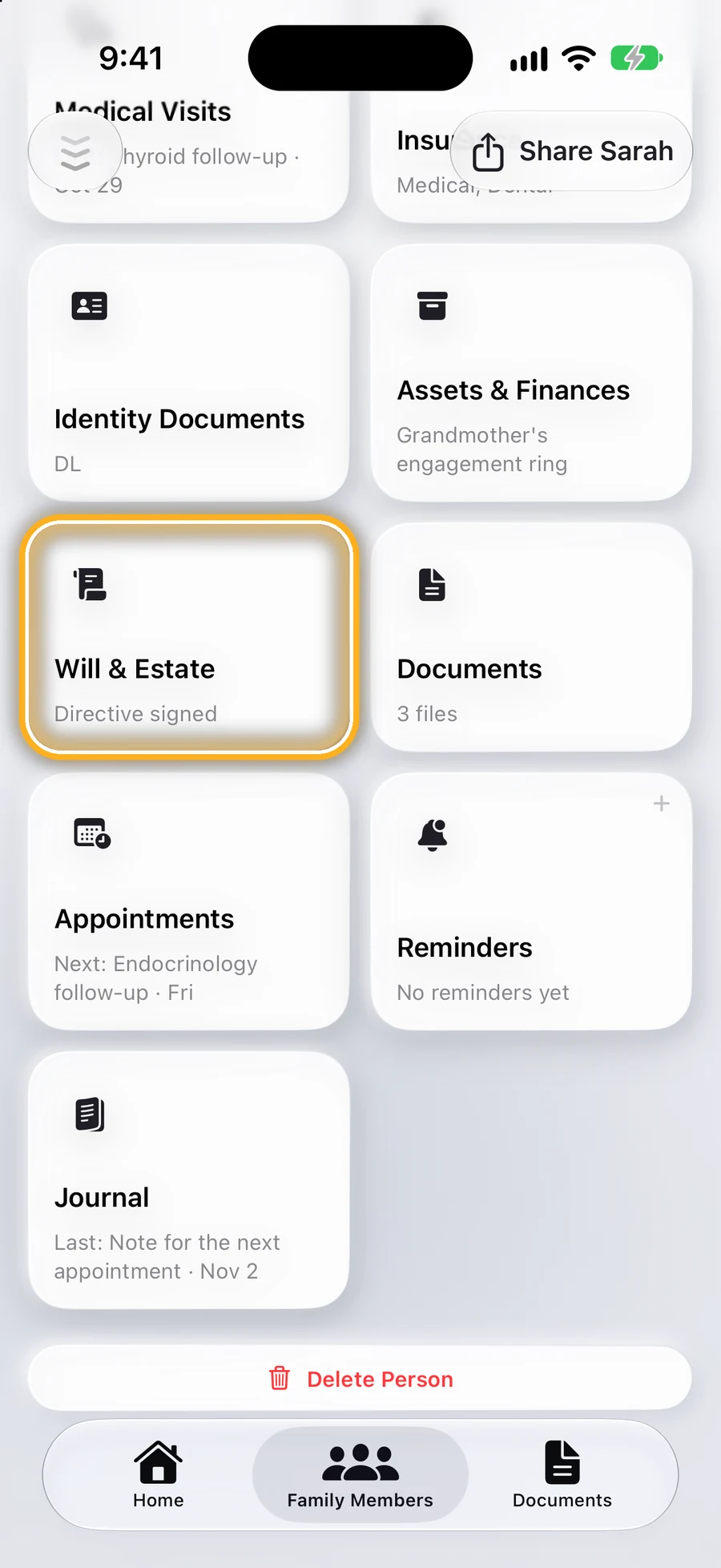
Step 1: Open the person, tap Will & Estate
Tap Add Record and pick Healthcare Directive. A will, a trust and a power of attorney go here too.
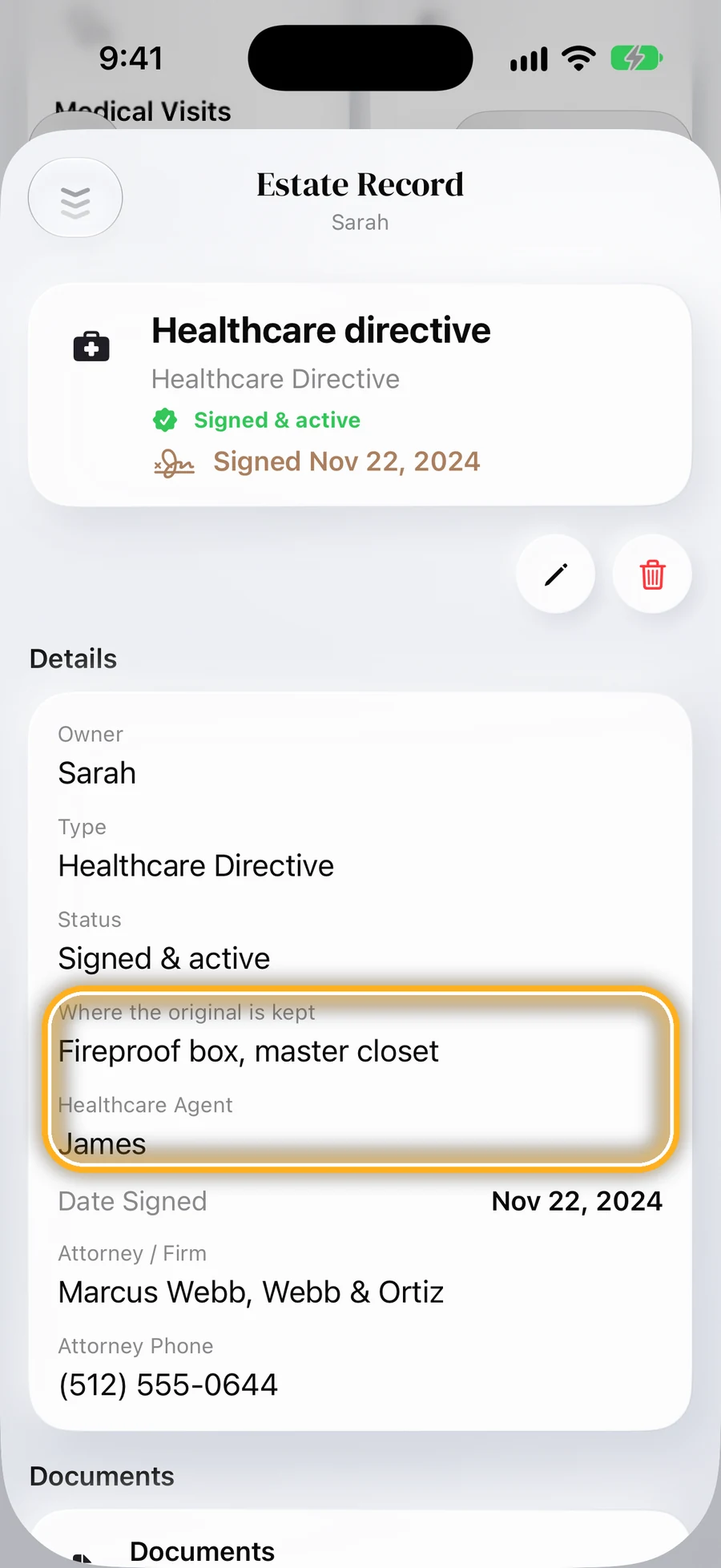
Step 2: Where the original is, and who the agent is
Save where the original is kept, the health care agent, the lawyer's phone, and a scan of the signed copy.
Quick questions
- What is an advance directive, in simple words?
- A legal paper that says what medical care you want, and who speaks for you, if you can't speak for yourself. It's also called an advance health care directive or a health care directive. It only counts when you can't tell doctors yourself.
- Is an advance directive the same as a living will?
- A living will is one kind of advance directive. It lists the treatments you'd want or not want. The other main kind, a durable power of attorney for health care, names the person who decides for you. Many people have both.
- What's the difference between an advance directive and a medical power of attorney?
- A medical (health care) power of attorney is part of an advance directive. It names your health care proxy. The advance directive can also include a living will with your treatment wishes.
- Do I need a lawyer?
- No. A lawyer can help, but many states have free forms you can fill in yourself. If you do have a lawyer, give them a copy.
- Can I fill in an advance directive online?
- Yes. Free options include PREPARE for Your Care and The Conversation Project. Some sites charge a fee. Make sure the form is accepted in your state and the website address starts with https.
- What happens if there's no advance directive?
- Your state's laws decide who makes medical decisions for you, usually a spouse, parents or adult children. An unmarried partner may be left out unless you named them.
- Do doctors have to follow it?
- It's legally recognized but not legally binding. Doctors will try to respect it. If one can't, they must tell your health care proxy right away and think about moving your care to another doctor.
- Where should I keep it?
- Somewhere safe that people can reach. Give copies to your health care proxy, your doctors and your family, and tell them where the original is. Some states keep a registry for it.
Read next
Sources
- National Institute on Aging: Advance directives for health care
- National Institute on Aging: Preparing a living will
This page is general information, not legal or medical advice. Rules and forms differ by state.
Write it down. Tell them where it is.
KinLine is free to start. No account, no sign-up.


Free to download · No account needed