























Guide for caregivers · About 5 minutes
Helping manage a parent's money
You started by paying one bill. Now you're the one who knows where everything is. Here's what to keep track of, and the rules that keep you and your parent safe.
By the KinLine team · Updated
Start with the power of attorney
A power of attorney is the paper that lets you act for your parent with money. Read it. It says what you can do, and whether it starts now or only when they can't decide for themselves.
Banks may ask for a copy. Give copies, never the original. If you don't have one yet, a lawyer can help your parent make one while they still can.
Make a list of what they own and owe
- Checking and savings accounts
- Pension, retirement, Social Security and other income
- The house or other property
- Cars
- Insurance policies
- Stocks, bonds and trusts
- Jewelry and other valuables
- What they owe: credit cards, loans, the mortgage
Write down the bank or company and a phone number, not passwords. Our free printable has a page for this.
The four rules
The Consumer Financial Protection Bureau sums up your job in four rules:
- Act only for your parent's good, not yours or anyone else's.
- Manage their money carefully. Pay bills and taxes on time.
- Keep their money separate from yours.
- Keep good records: every check, every receipt, even small ones.
It helps to let a brother or sister see the records too. Questions are easier to answer when everyone can see the same list.
Watch for scams
Call adult protective services or the bank if you notice:
- Money or things missing
- Large withdrawals or wire transfers nobody can explain
- Bills that suddenly go unpaid
- A new "best friend" or helper who's handling their money
- Changes to a will, life insurance or retirement beneficiary
One list, the whole family can see
Here's Robert, 71, from our sample family.

Step 1: Assets & Finances, and Will & Estate
Open your parent and tap Assets & Finances for the accounts. The power of attorney goes in Will & Estate.
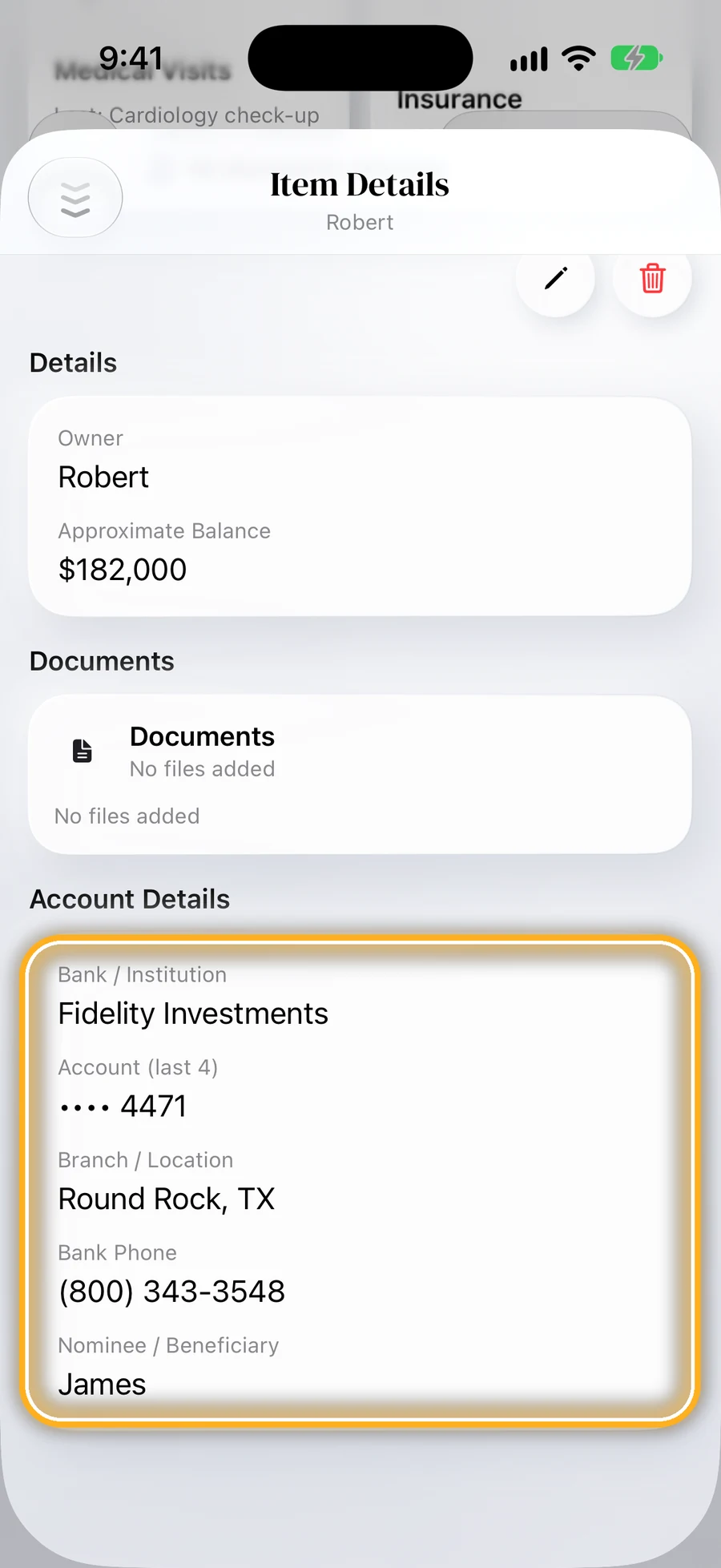
Step 2: The bank, the last 4 digits, who to call
KinLine keeps only the last 4 digits of an account. That's enough to know which one it is.

Step 3: Share it with your brother or sister
On iPhone, tap Share, then Share via iCloud. Everyone sees the same list, and every change.
Quick questions
- Does a power of attorney let me manage Mom's Social Security?
- No. The CFPB explains that Social Security and VA benefits need their own appointment, called a representative payee or VA fiduciary. Call Social Security at 1-800-772-1213, or the VA at 1-888-407-0144.
- Can I put Dad's money in my account to make it easier?
- No. Keep his money in his name and his accounts. Mixing it with yours makes it hard to show what's his, and can get you in trouble.
- What happens to the power of attorney when a parent dies?
- It ends, and you can't pay their bills from their accounts any more. Tell the bank and the other places you dealt with.
- Who can help if I think someone is taking advantage of my parent?
- Adult protective services. Find yours through the Eldercare Locator at 1-800-677-1116. If they're in danger right now, call 911.
Read next
Sources
This page is general information, not legal or financial advice. Ask a lawyer about your own situation.
Their money, clearly theirs, and easy to find.
KinLine is free to start. No account, no sign-up.


Free to download · No account needed